
Unit Price Calculator
Is the big pack really cheaper? Enter each option’s price and size — in grams, ounces, pounds, litres, fluid ounces or items, and even as multipacks — and the calculator converts them to the same unit price, ranks them from best value to worst and shows how much you save per unit and on the amount you need.
- Free to use
- No sign-up
- Runs in your browser
Unit price calculator
Smart Shopping Pack
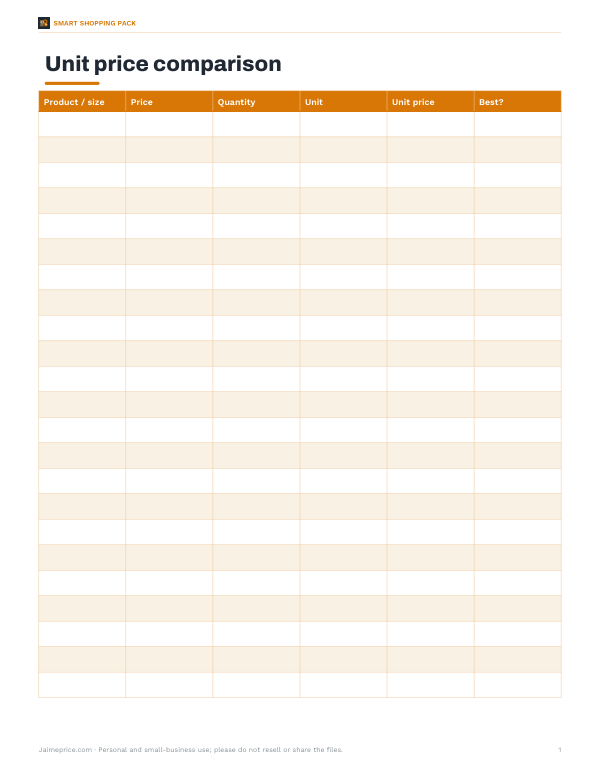
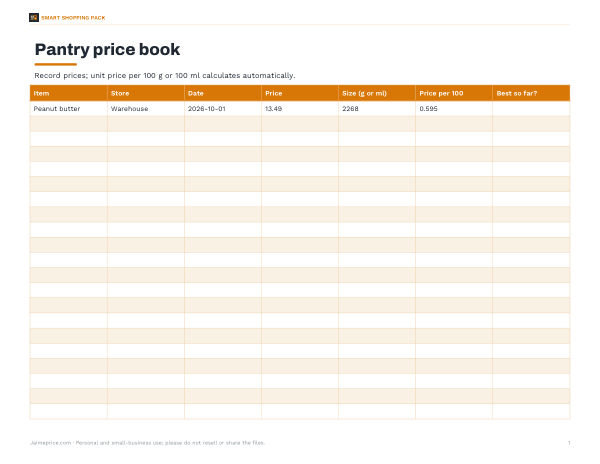
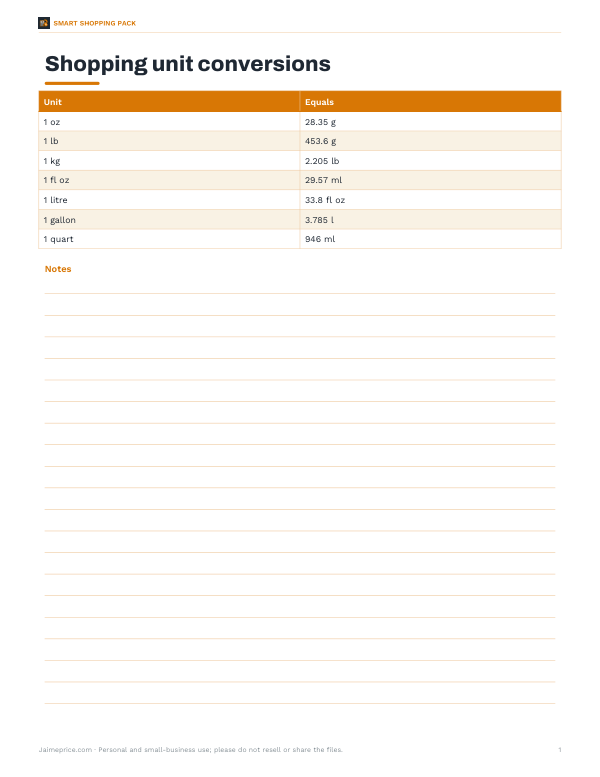
Printable price comparison worksheet, pantry price book (Excel) that tracks your best unit prices by store, a unit conversion card and a grocery list template.
- Comparison worksheet (PDF)
- Price book (XLSX)
- Conversion card (PDF)
- Grocery list (PDF, DOCX)
Formats: PDF, DOCX, XLSX. Instant download after payment (link valid 72 hours, up to 5 downloads). AI-assisted: the templates were drafted with AI help and reviewed and laid out before publishing.
$3.00 USD, one-time 4 files · about $0.75 each
- Instant download
- 7-day refund
- Secure checkout by Stripe
7-day money-back guarantee. Full refund within 7 days of purchase, even after you download.
Free sample: Grocery List Template (PDF, 53 KB)
Full refund within 7 days — see the refund policy and license.
Free printables
Single sheets you can print right now, no sign-up. The full pack adds every sheet in one download plus the editable files.
 Printable Grocery List
What unit price means
The unit price is the cost per standard amount — per ounce, per 100 grams, per litre or per item. It lets you compare packs of different sizes fairly. A 340 g jar at $3.49 costs about $1.03 per 100 g, while a 1 kg jar at $6.29 costs about $0.63 per 100 g — so the bigger jar is almost 40% cheaper per gram, even though it costs more at the till.
The formula
| Step | Example |
|---|---|
| Convert every option to the same unit | 12 oz × 2 packs = 24 oz = 680 g |
| Divide price by quantity | $5.99 ÷ 680 g = $0.0088 per g |
| Scale to a readable unit | × 100 = $0.88 per 100 g |
| Compare | Lowest unit price is the best value |
Unit conversions used
| Unit | Equals |
|---|---|
| 1 oz (weight) | 28.35 g |
| 1 lb | 453.6 g = 16 oz |
| 1 kg | 1,000 g = 2.205 lb |
| 1 US fl oz | 29.57 ml |
| 1 litre | 1,000 ml = 33.8 US fl oz |
| 1 US gallon | 3.785 litres |
Weight ounces and fluid ounces measure different things: compare weight with weight and volume with volume. The calculator only compares options of the same kind.
How to use the calculator
- List each option on its own line: name | price | quantity | unit, adding a pack count for multipacks.
- Read the ranking — the best value is highlighted and others show how much more they cost per unit.
- Enter how much you actually need to see the cost and your saving on that amount.
- Change prices to check whether a sale or coupon changes the winner.
Worked example
Comparing peanut butter: a 340 g jar at $3.49, a 1 kg jar at $6.29, a twin pack of 12 oz jars at $5.99 and a 5 lb warehouse tub at $13.49. Converted to price per 100 g, the tub is about $0.59, the 1 kg jar $0.63, the twin pack $0.88 and the small jar $1.03. The tub is the best value per gram — but only if you will use 2.27 kg before it goes stale.
When the cheapest unit price isn’t the best buy
- You won’t use it before it spoils or expires.
- You don’t have room to store it.
- The larger pack ties up money you need elsewhere.
- Quality or brand differs — compare like with like.
- A coupon or loyalty discount applies only to the smaller size.
Everyday comparisons
| Product | Compare by |
|---|---|
| Cereal, coffee, rice | Price per 100 g or per pound |
| Milk, juice, oil | Price per litre or per gallon |
| Toilet paper | Price per 100 sheets (not per roll — roll sizes vary) |
| Nappies/diapers | Price per nappy of the same size |
| Laundry detergent | Price per load, not per litre |
| Batteries | Price per battery of the same type |
For products like toilet paper and detergent, the useful unit is a sheet or a wash, because packs describe “mega rolls” and concentrates in different ways.
Multipacks and bulk buys
Multipacks are usually but not always cheaper per unit. Supermarkets sometimes price single items on promotion below the multipack rate, and warehouse clubs may charge more per unit for some brands. Always convert to the same unit. If you buy in bulk, check use-by dates and whether you have space to store the extra — waste cancels the saving.
Shrinkflation
When package sizes shrink while prices stay the same, the unit price rises even though the shelf price hasn’t changed. Comparing unit prices over time — for example in the price book workbook in the printable pack — reveals these hidden increases and helps you switch to better-value alternatives.
Store brands vs name brands
Store-brand products are often made to similar specifications and can be 20–40% cheaper per unit. Compare unit prices across brands as well as sizes, and try the store brand for staples such as flour, sugar, rice and cleaning products, where differences are small. For items where you care about taste or performance, a small premium may be worth paying — the calculator shows exactly how big that premium is.
Using the calculator in the shop
- Open the page on your phone before shopping.
- Type each option as you compare shelves.
- Check that you’re comparing the same quality and brand level.
- Use the “how much do you need” box for recipes or bulk buys.
- Note the winner in your shopping list for next time.
Shelf labels
Many supermarkets print unit prices on shelf labels, but they sometimes use different units for different products (per 100 g on one, per kg on another) or per-item pricing on multipacks. Converting everything to the same unit, as the calculator does, avoids being misled.
Privacy
Everything runs in your browser; nothing is uploaded.
Frequently asked questions
How do I calculate unit price?
Divide the price by the quantity in a common unit, such as grams or ounces.
Is bigger always cheaper?
Often but not always — check the unit price.
How do I compare multipacks?
Multiply the size by the number of packs before dividing.
Can I compare ounces and grams?
Yes, the calculator converts them automatically.
Can I compare weight and volume?
No — they measure different things; compare like with like.
What is a good unit to compare toilet paper?
Price per 100 sheets, because roll sizes vary widely.
Does the calculator handle cents?
Yes, enter prices like 3.49; unit prices under a dollar show three decimals.
Is my data stored?
No, it runs in your browser.